
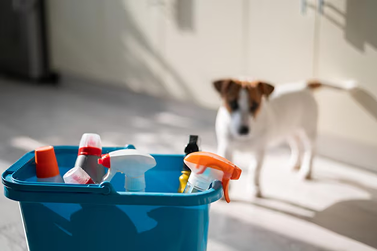
When owners ask themselves whether cleaning products are harmful to animals, at most they think about the smell of bleach and irritation. But in practice, the situation is much more complicated and dangerous. Because household chemicals are not only what we see and feel. They are also what remains in the air, on surfaces, and then in microscopic amounts gets into the bodies of animals.
It is important to remember that pets are not small people. Physiology makes them much more vulnerable:
- higher respiratory rate;
- small height at the withers and constant contact with the floor;
- sensitive skin and fur, in which residues of cleaning products are retained;
- licking of fur and paws;
- sensitive sense of smell.
Because of this, even minimal chemical residues on the floor or furniture turn into a regular dose of exposure and lead to dangerous consequences.
How do household chemicals affect animals?
Veterinarians identify several main body systems of animals that suffer from contact with components of household chemicals. Let’s look at this in more detail.
Respiratory system
Most traditional washing and cleaning products contain volatile organic compounds (VOCs). During and after cleaning, they evaporate into the air and in the shortest possible time get into the animal’s lungs. Among the consequences are:
- irritation of the mucous membranes;
- coughing, with the risk of becoming chronic;
- development and worsening of asthma;
- deterioration of oxygen exchange.
According to the U.S. Environmental Protection Agency, the level of VOCs indoors after cleaning can be 2–10 times higher than normal for several hours. This significantly affects people as well, and animals, with their size and sensitive organs, have it even worse.
Skin and fur
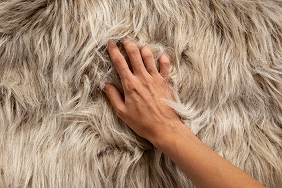
The protective barrier of an animal’s body is the first to take the blow from household chemicals. Components in cleaning products destroy the lipid layer of the skin, which is responsible for retaining moisture, protecting against bacteria and allergens, as well as the elasticity and health of the skin. As a result of regular contact, the following occur:
- dryness and flaking;
- microcracks;
- itching and constant licking;
- redness and inflammation.
In this case, fur does not help, but, on the contrary, worsens the situation. It works like a sponge, holding chemical residues and prolonging contact with the skin.
Digestive system
Most owners fear that a cat or dog may accidentally swallow toxic components of cleaning products. And this is logical, because it is not for nothing that even the packaging says to store bottles and packages in places inaccessible to children and pets. But the unpleasant point is that dangerous substances in household chemicals can get into the body not only because of direct swallowing. One of the most non-obvious and underestimated problems is secondary ingestion, almost invisible to the owner. And all because pets lick themselves.
Grooming is an integral attribute of life. Cats, dogs, rodents, and rabbits regularly lick themselves. Especially after contact with anything. Therefore, if traces of cleaning products and unsafe components remain on surfaces, they inevitably get into the animal’s body.
Cats are in the highest-risk group. Among the reasons for this are:
- Active licking. A cat spends up to 30–50% of its waking time on hygiene. Don’t believe it? Try timing it sometime.
- Features of the tongue. Because of its rough structure, a cat collects particles from its fur literally like a brush.
- High sensitivity to chemical compounds and small body weight, because of which even microdoses are critically dangerous.
Nervous system
When considering how household chemicals affect animals, one cannot overlook the fact that some components can affect neurotransmitters. In animals, this leads to anxiety, disorientation, and in severe cases to seizures.
Dangerous substances for pets
When figuring out how to protect animals from household chemicals, and whether there are safe cleaning products for animals, it is important to understand that the danger is not the product as a whole, but specific chemical elements in its composition. For example:
- Chlorine and chlorine-containing compounds. One of the most common components in household chemicals. They have strong oxidizing properties, destroy bacteria, but at the same time irritate tissues. They cause burns of the mucous membranes when inhaled, irritation, nausea, and vomiting. Even the residual amount after cleaning already creates a problem for the pet’s health.
- Surfactants — the harm to animals lies in the fact that these components break down dirt and detach it from the surface. But the problem is that they cannot distinguish between dirt and the protective structures of a cat’s or dog’s body. Anionic surfactants are especially dangerous, which, unfortunately, are most often used in aggressive household chemicals from stores and supermarkets.
- Ammonia. Mainly used in glass cleaners and universal cleaners. It is dangerous because of its sharp smell and high volatility.
- Phenols. Found in disinfectants. They are especially dangerous for cats, as they are not able to effectively metabolize phenols. Even small doses are dangerous, causing intoxication, liver damage, and neurological disorders.
- Synthetic fragrances and flavorings — in this case, the harm to animals is caused by phthalates, aldehydes, and solvents. Because of this, irritation of the mucous membranes, sneezing, and coughing occur. And the most dangerous thing is the risk of an accumulative effect.
- Preservatives and stabilizers. An invisible but dangerous part of the composition, for example, formaldehyde and its derivatives. They cause irritation, allergies, and intensify the toxic effect of other components.
How to recognize that household chemicals are already affecting an animal?
Veterinarians identify a set of early signals that owners often ignore. Among them are sneezing after cleaning, coughing, or heavy breathing in closed rooms. Constant licking of paws, redness of the paw pads, and itching without parasites. In addition, the animal may avoid certain rooms after cleaning, be restless or irritable. In the case of gastrointestinal problems, these are episodic vomiting and unstable stool.
In these cases, the first thing that needs to be done is to show the animal to a veterinarian, and afterward — to deal with the household chemicals.
Safe cleaning products for animals
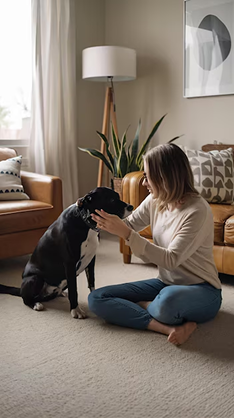
Any responsible and loving owner, after understanding the risks, asks the question: is it even possible to use cleaning products if there are animals? Of course it is possible. The main thing is the right choice, taking into account the needs of the beloved pet.
That is exactly why more and more owners choose eco-friendly products for homes with animals. This is not just a trend, but a logical transition to a safer environment for the pet. Such products are based on an optimized mixture of beneficial bacteria that work differently from familiar chemicals. That is, they do not aggressively destroy everything in a row, including the skin, microflora, and mucous membranes of animals, but act directly on pollution molecules. Natural cleaning products from Step2Clean work precisely. Special substances dissolve organic compounds — fats, proteins, starches, and sugars — that accumulate on hard and soft surfaces. Without aggressive impact, toxic fumes, or influence on the body of pets, and people too.
Eco-friendly products for homes with animals do not contain aggressive solvents, chlorine, ammonia, or harsh fragrances. Odorless products for animals do not provoke allergic reactions. And natural surfactants, which are included in the composition in minimal concentration, do not have a harmful effect on the skin, paws, fur, breathing, or digestion of the pet. As a result — not just a clean home, but a safe space where the animal can calmly walk, lie down, and lick itself without risk to health. Choose natural cleaning products from Step2Clean, because true care begins with small things.